
Can AI help you earn money in 2026? Yes—but not through the “press a button and get rich” promises that fill social feeds. The dependable opportunity is simpler: use AI to deliver a useful result faster, then charge for your judgment, editing, strategy, or implementation.
This guide turns current search findings into a practical plan for beginners, freelancers, and bloggers. It focuses on realistic services and small digital businesses rather than guaranteed income. Your results will depend on your skills, market, consistency, and the quality of the outcome you deliver.
What the current market is actually rewarding
Recent 2026 guides from Shopify and Oxford Home Study broadly point to the same pattern: AI is lowering the time required for writing, design, research, video, customer support, marketing, and basic automation. That does not make raw AI output valuable by itself. Clients pay for a solved problem—clearer content, more qualified leads, a better product page, a useful dashboard, or fewer repetitive tasks.
The strongest beginner opportunities combine an existing human skill with an AI-assisted workflow:
- Content operations: research, outlines, editing, repurposing, newsletters, and social captions.
- Visual production: thumbnails, simple ad creatives, product mock-ups, and presentation graphics.
- Business support: research summaries, inbox systems, FAQ knowledge bases, and workflow documentation.
- Digital products: checklists, templates, planners, prompt systems, and niche learning resources.
- Marketing assistance: keyword clustering, content briefs, email drafts, and conversion experiments.
Five realistic AI income paths for beginners
1. Sell an AI-assisted content service
Do not sell “AI writing.” Sell a defined deliverable such as four edited blog briefs, a weekly newsletter, ten product descriptions, or a monthly content refresh. AI can help with ideation and first drafts; you remain responsible for fact-checking, tone, originality, structure, and final usefulness.
2. Become the editing and quality layer
Many businesses can generate text but cannot turn it into trustworthy communication. Offer fact-checking, brand-voice editing, source checking, formatting, and content updates. This is especially suitable if you already understand a niche such as blogging, finance, education, technology, or ecommerce.
3. Build small-business automation packages
Use no-code tools and AI assistants to map a repetitive process: answering common questions, summarising enquiries, sorting leads, drafting replies, or creating an internal knowledge base. Start with one workflow and document what happens before and after your intervention. Avoid promising a fully autonomous system when human review is still necessary.
4. Create a focused digital product
A generic prompt bundle is easy to copy. A practical, niche-specific toolkit is more useful: a content calendar for local restaurants, a client onboarding checklist for freelancers, or a spreadsheet that helps creators plan sponsorship outreach. Use AI to speed up research and layout, then add your own examples, testing, and instructions.
5. Use AI to improve an existing blog or affiliate project
AI can help cluster search questions, compare content gaps, draft outlines, and identify pages that need updating. It cannot replace first-hand insight, accurate product evaluation, or a sustainable audience strategy. Treat affiliate income as a longer-term asset: publish useful comparisons, disclose commissions, and measure clicks and conversions rather than chasing volume.
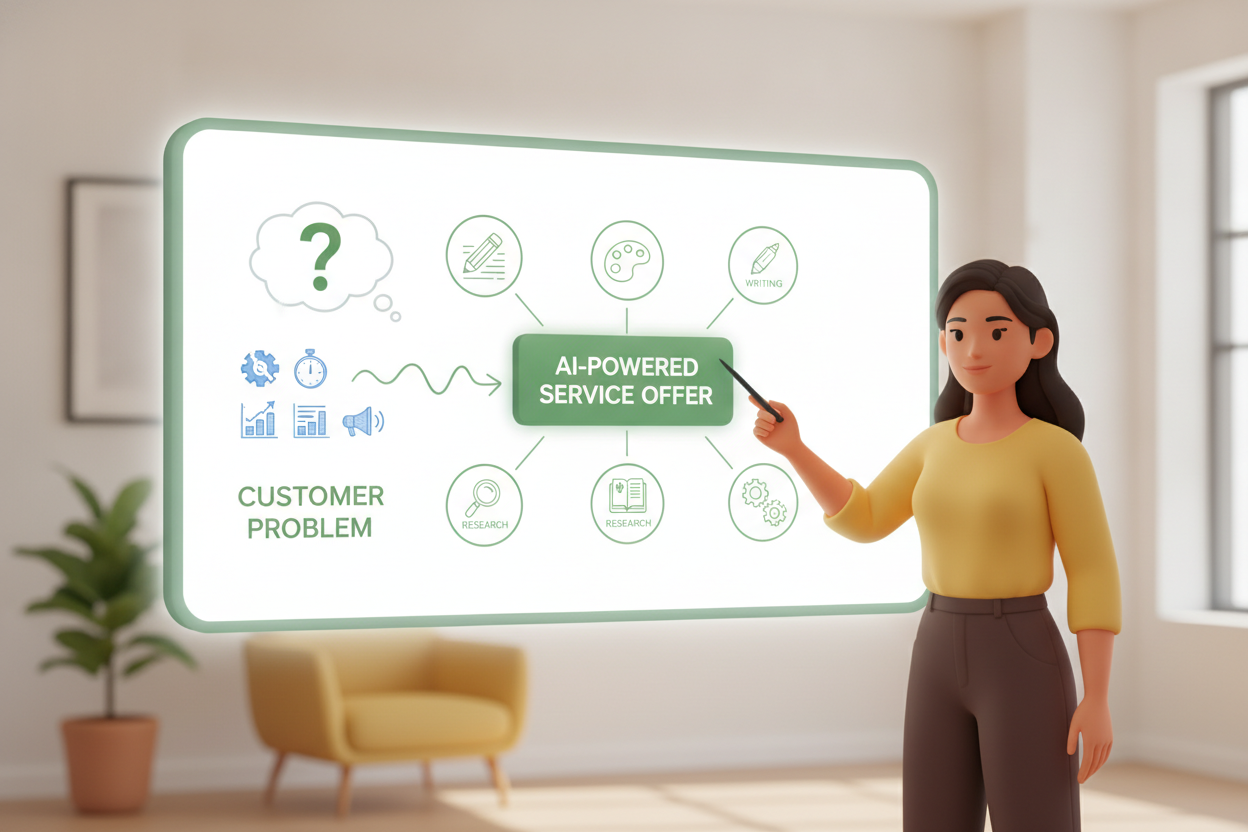
How to choose one offer people can understand
Use this four-part filter before buying tools or building a website:
- Audience: choose a group you can reach, such as local businesses, coaches, ecommerce sellers, or creators.
- Pain: identify a recurring task that costs them time, delays sales, or creates inconsistent quality.
- Proof: make one sample using a fictional or permission-based project. Show the input, your process, and the finished result.
- Package: define the exact deliverable, turnaround time, revision limit, and starting price.
A narrow offer is easier to improve and sell than “I can do anything with AI.” For example, “I create and edit eight conversion-focused product descriptions for Indian ecommerce brands” is clearer than “AI content services.”
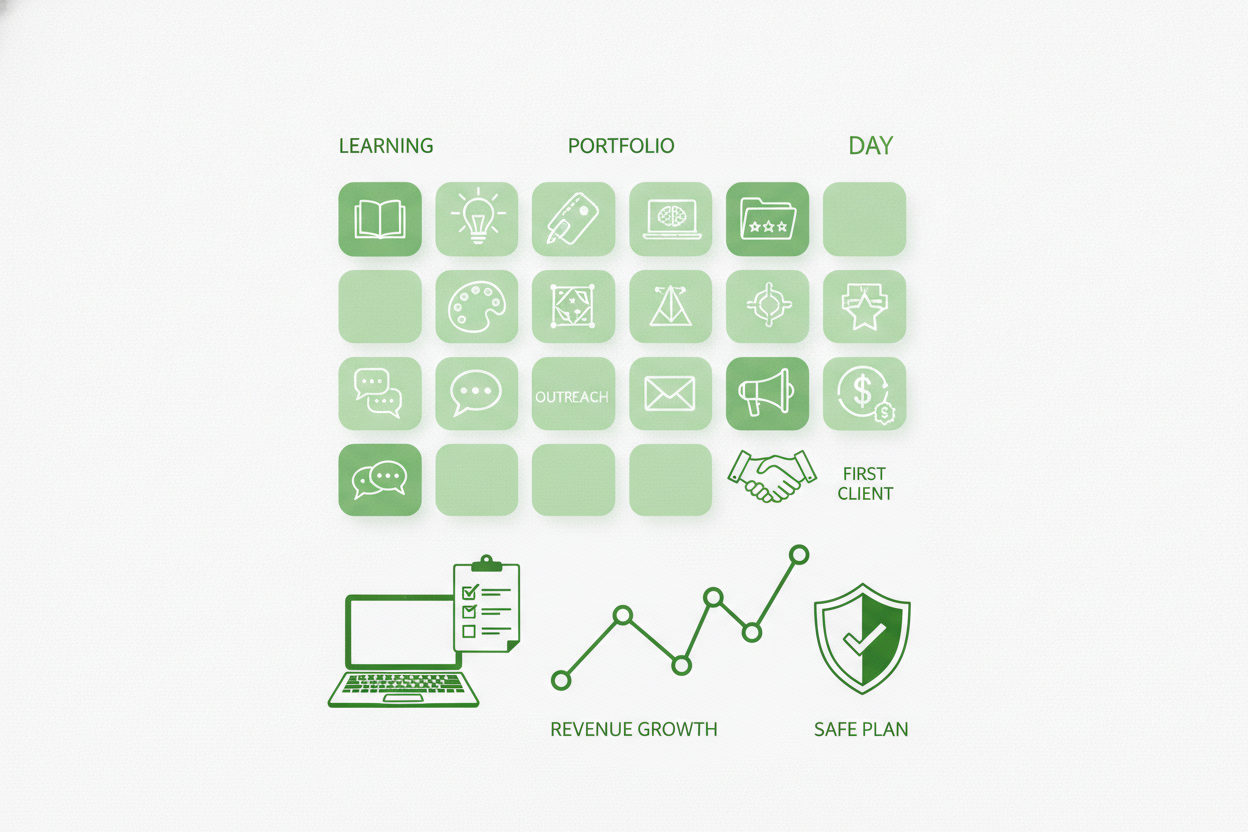
A realistic 30-day launch plan
Days 1–7: learn and select
Test two or three tools against one real task. Record where the output fails. Choose a service that matches your existing ability and write a one-sentence promise focused on the customer’s result.
Days 8–14: build proof
Create two or three portfolio samples. Include a short explanation of your decisions and a quality checklist. Ask a trusted person in your target market what they would change before you publish the offer.
Days 15–21: start conversations
Contact a small, relevant list of potential clients with a specific observation—not a mass-produced pitch. Offer a small paid pilot or a clearly scoped starter package. Track replies, objections, time spent, and the value clients mention.
Days 22–30: improve and repeat
Refine the offer based on real questions. Turn repeatable steps into a checklist, raise the price when the outcome improves, and request permission to use completed work as a case study. A repeatable workflow is more valuable than a collection of disconnected prompts.
What can you realistically earn?
There is no universal AI rate. Basic editing, research, and admin tasks may begin as small fixed-price projects, while specialist automation, analytics, and implementation can command much more. The useful calculation is:
Monthly income = number of completed projects × price per project − tool and operating costs.
Start with a price that covers your time, revisions, communication, and delivery—not just the minutes spent inside an AI tool. As your process becomes faster, keep the benefit as margin rather than automatically discounting your work. Do not publish income claims without evidence, and never promise a timeline or result that you cannot control.
How to avoid AI income scams
Be cautious when a course, software product, or “automation system” promises guaranteed daily earnings, effortless passive income, or secret access to clients. Check the company, cancellation terms, privacy policy, commercial-use rights, and independent reviews before paying. Do not upload confidential client information into a tool without permission, and keep a human review step for financial, legal, medical, hiring, or safety-related work.
AI-generated images and text can also raise copyright, likeness, trademark, and platform-policy questions. Keep records of your source material and tool terms, avoid copying competitors, disclose AI assistance when a client or platform requires it, and add original human direction to every deliverable.
A simple tool stack to begin
- One general AI assistant for brainstorming and structured drafts.
- One document or spreadsheet tool for organising research and delivery.
- One design or image editor for client-ready visual work.
- A portfolio page or shared folder with three focused samples.
- A measurement sheet for leads, conversion, hours, revenue, and expenses.
Start on free plans where practical. Upgrade only when a paid feature saves enough time or improves the result enough to justify its cost. Tool-hopping feels productive but rarely creates income.
FAQs
Do I need coding skills?
No. Content editing, design support, research, digital products, and many administrative workflows can begin without coding. Coding becomes useful when you want to build custom software or deeper integrations.
Can AI income be passive?
Digital products and affiliate content can continue earning after publication, but they still require research, promotion, updates, customer support, and quality control. “Semi-passive” is a more honest description than “hands-off.”
What is the fastest way to get a first client?
Choose a narrow service, produce credible samples, and contact people who already have the problem. A relevant conversation and a small paid pilot are usually more useful than publishing dozens of generic AI posts.
Final takeaway
The best way to make money with AI in 2026 is to stop treating AI as the product. Treat it as leverage inside a useful product or service. Pick one audience, solve one recurring problem, verify every important output, and use the first 30 days to learn what customers will actually pay for. That approach is slower than a viral promise—but far more likely to become dependable income.
Research note: This article was informed by live search results and extracted 2026 guidance from Shopify India and Oxford Home Study. Examples and recommendations are original editorial synthesis, not income guarantees.
